
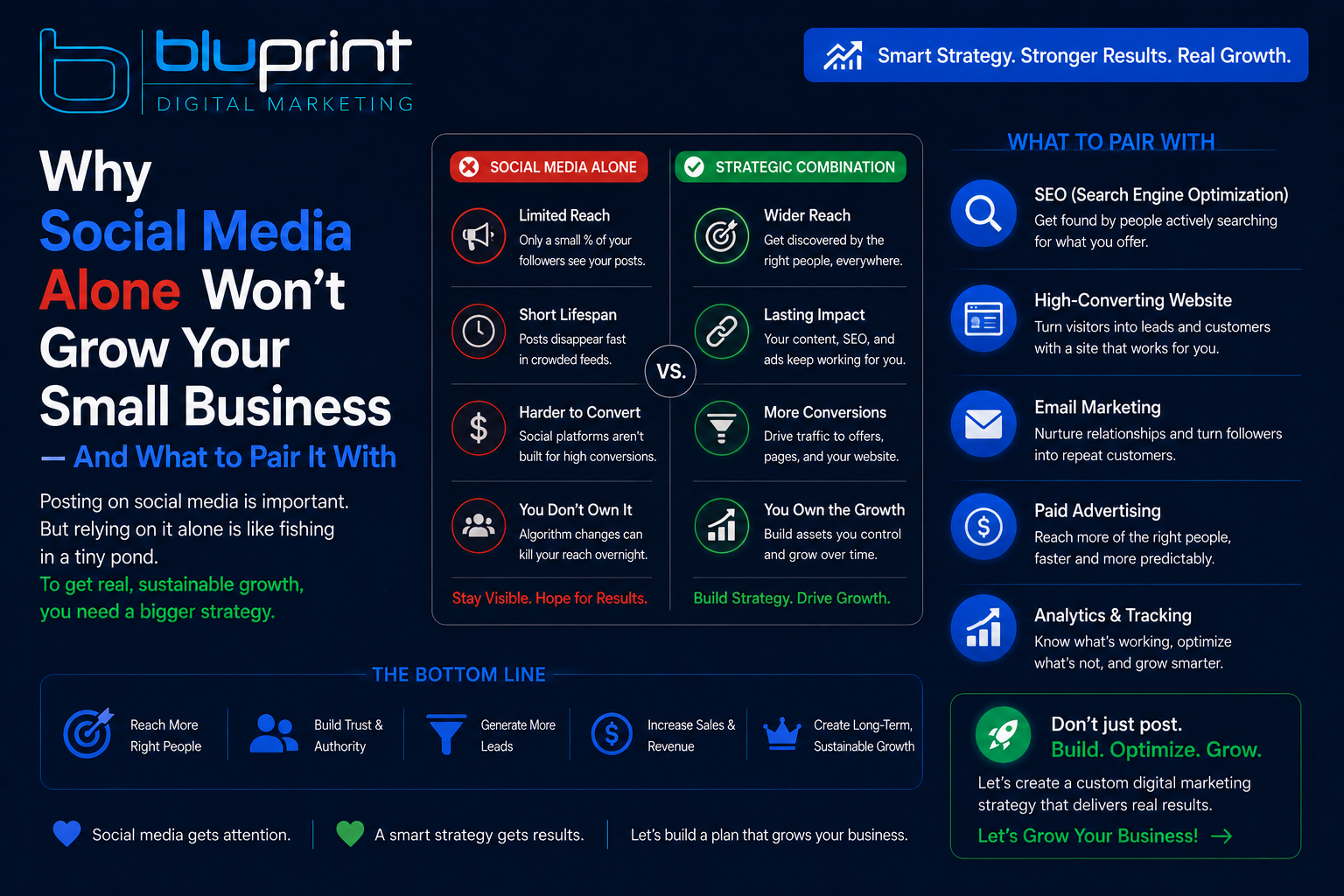
Why Social Media Alone Won’t Grow Your Small Business — And What to Pair It With
Social media is the first place most small business owners turn when they decide to invest in marketing. It feels accessible, it’s free to start, and the idea of building a following and generating business from it is genuinely appealing. The problem is that for most service-based small businesses, social media alone rarely moves the needle the way business owners hope it will.
That doesn’t mean social media isn’t valuable — it absolutely is. But understanding what it’s actually good for, and what it can’t do on its own, is the difference between a marketing strategy that works and one that feels like a lot of effort for not much return.
What Social Media Is Actually Good For
Social media excels at one thing above all others — building trust with people who already know you exist. When someone finds your business through Google, sees your ad, gets a referral from a friend, or drives past your shop, the next thing they do is look you up on social media. What they find there either reinforces or undermines their confidence in choosing you.
An active, well-maintained social media presence with real photos, genuine reviews, behind-the-scenes content, and evidence of your work tells a potential customer that you’re legitimate, active, and worth reaching out to. An inactive or absent social media presence raises questions.
Social media is also excellent for staying top-of-mind with existing customers — the people who have already done business with you and might hire you again or refer someone they know. Consistent posting keeps your business in front of that audience in a low-pressure way.
What Social Media Struggles to Do
Where social media falls short for most small businesses is generating net-new demand. Organic social media reach — especially on Facebook and Instagram — has declined dramatically over the last several years. The platforms have shifted toward pay-to-play models, and the reality is that most of your posts are only being seen by a small fraction of your followers.
More importantly, the people scrolling through social media aren’t actively looking for what you offer. They’re browsing, being entertained, staying connected with friends and family. Converting a passive scroller into a paying customer requires a lot more touchpoints and a lot more time than converting someone who actively searched for your service on Google.
If your goal is to generate new leads and new customers — not just stay connected with existing ones — social media organic posting alone is unlikely to get you there at scale.
What to Pair Social Media With
The businesses that grow consistently online aren’t relying on any single channel. They’re using a combination of tools where each one does what it’s best at.
Google Ads is the most direct path to new customers for most service businesses. The people clicking on your Google Ads are actively searching for what you offer right now — they have a problem and they’re looking for someone to solve it. That intent is enormously valuable and it’s what makes Google Ads the highest-converting digital channel for most local service businesses.
SEO builds long-term organic visibility in Google search results — the free listings that appear below the ads. SEO takes time to build but compounds over time and delivers traffic without an ongoing cost per click. A business that invests in SEO consistently for 12-18 months often finds it becomes their highest-volume source of inbound leads.
Your website is the hub that everything else points to. A fast, professional, conversion-optimized website turns traffic from all your other channels into actual leads. Social media posts, Google Ads, and SEO all drive traffic somewhere — if that somewhere isn’t built to convert, the investment in those channels is being wasted.
The Right Role for Social Media in Your Strategy
None of this means you should ignore social media. A consistent, authentic social media presence reinforces your credibility, keeps your existing audience engaged, and supports every other marketing channel you’re running. When someone clicks your Google Ad and lands on your website, they may check your Facebook or Instagram before they call. What they find there matters.
The shift in thinking is to stop viewing social media as a primary lead generation tool and start viewing it as a trust-building and retention tool — one important piece of a multi-channel strategy rather than the whole strategy itself.
At Bluprint Digital Marketing, we help Colorado businesses build marketing strategies that actually drive growth — combining Google Ads, SEO, social media, and web design in a way that makes each channel stronger. If you’re putting time and money into social media and not seeing the results you expected, let’s talk about what a more complete strategy might look like for your business.