What Is SEO and How Long Does It Actually Take to Work?
If you’ve ever asked a marketing agency about SEO and walked away more confused than when you started, you’re not alone. SEO is one of the most misunderstood services in digital marketing — oversold by some agencies, dismissed as too slow by others, and mysterious to most business owners who just want more customers.
This article cuts through the noise. Here’s what SEO actually is, how it works, how long it realistically takes, and whether it’s worth it for your business.
What Is SEO?
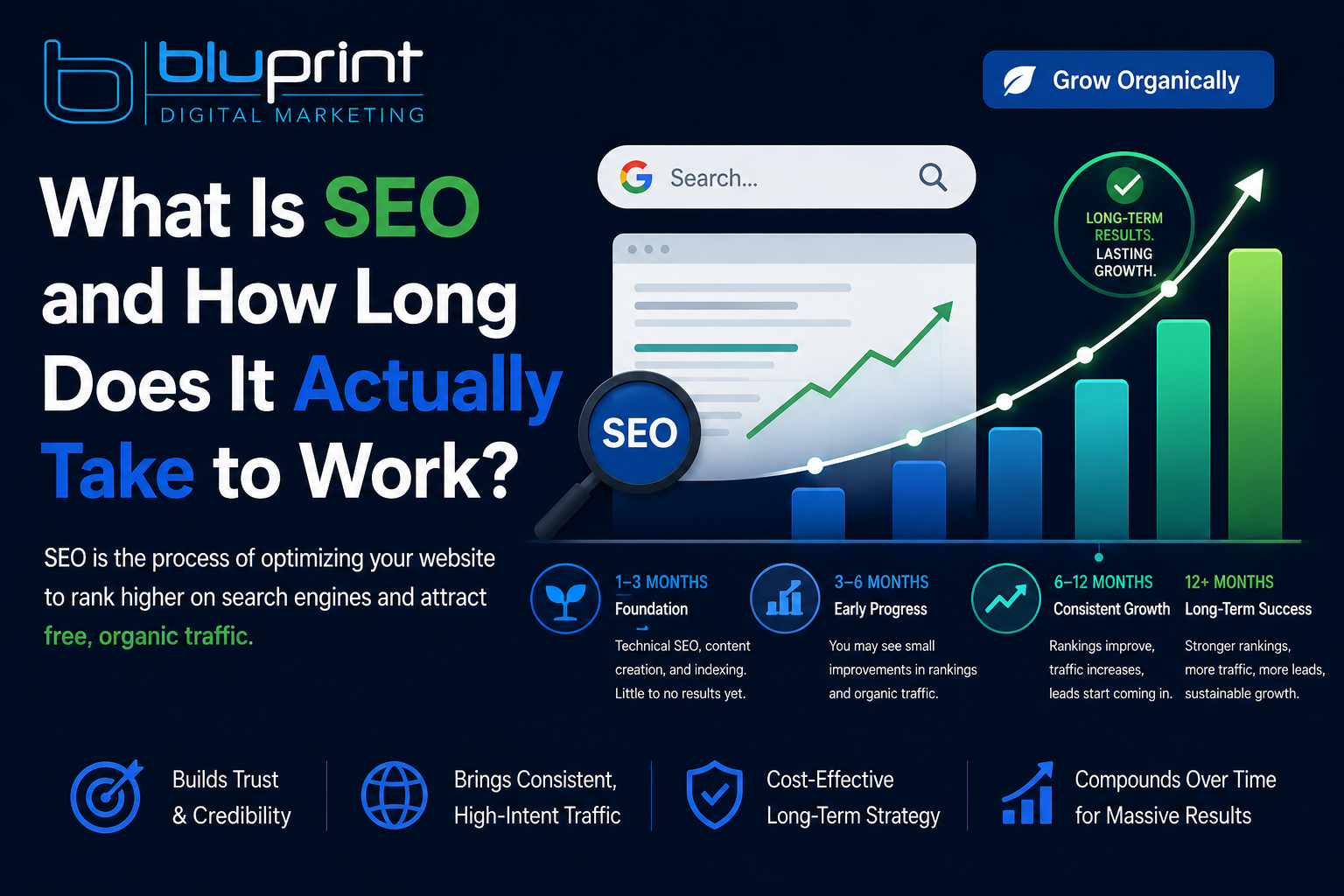
SEO stands for Search Engine Optimization. At its core, it’s the process of making your website more visible in Google’s organic (unpaid) search results.
When someone searches “divorce attorney Colorado Springs” or “hail damage repair near me,” Google scans billions of web pages and decides which ones to show — and in what order. SEO is the work you do to convince Google that your website deserves to be at or near the top of those results.
Unlike Google Ads, where you pay for every click, organic search traffic is free. Once you’re ranking well, clicks don’t cost you anything. That’s the promise of SEO — and it’s a real one. But it comes with a catch: it takes time.
How Does Google Decide Who Ranks?
Google’s ranking algorithm considers hundreds of factors, but they generally fall into three buckets:
Relevance — Does your page actually answer what the searcher is looking for? This comes down to the content on your site — the words you use, the topics you cover, and how well your pages match the intent behind specific searches.
Authority — Does Google trust your website? Trust is largely built through backlinks — other reputable websites linking to yours. The more quality sites that link to you, the more Google sees your site as an authority in your space.
Experience — Is your website fast, mobile-friendly, secure, and easy to use? Google cares about the experience users have when they land on your site. A slow, clunky, or unsecured site will struggle to rank regardless of how good your content is.
SEO is the work of improving your site across all three of these dimensions — simultaneously and consistently over time.
So How Long Does It Actually Take?
Here’s the honest answer most agencies won’t give you: for most businesses in competitive markets, SEO takes 4 to 12 months to show meaningful results.
That’s a wide range, and it depends on several factors:
Your starting point. A brand new website with no history, no content, and no backlinks is starting from zero. An established site that already ranks for some terms just needs to be pushed further. Starting from zero takes longer.
Your competition. If you’re a plumber in a small town with few competitors online, you might rank within a few months. If you’re a personal injury attorney in Denver competing against law firms that have been investing in SEO for years, it could take 12 months or more to break into the first page.
How aggressively you invest. SEO is not a set-it-and-forget-it service. The more consistently you publish content, build links, and optimize your site, the faster results come. Doing the minimum produces minimum results.
Your industry. Some industries are more competitive online than others. Legal, medical, financial, and home services tend to be the most competitive. Niche businesses or those in smaller markets often see results faster.
What Happens During Those First Few Months?
A lot of business owners get discouraged during the early months of SEO because they don’t see dramatic changes right away. But that doesn’t mean nothing is happening.
Months 1-2: Foundation This is when the technical work gets done. Fixing site speed issues, correcting technical errors, setting up proper tracking, researching keywords, and optimizing existing pages. This work doesn’t produce immediate rankings, but it’s essential — you can’t build on a cracked foundation.
Months 3-4: Content and Signals New content starts going live. Google begins crawling and indexing the updated site. You might start seeing small movement on lower-competition keywords. Backlink building efforts begin. This phase feels slow but the signals are accumulating.
Months 5-8: Momentum This is where you start seeing real movement. Rankings improve on multiple keywords. Organic traffic begins to climb. Some pages break onto the first page. The momentum that’s been building starts becoming visible in your analytics.
Months 9-12+: Compounding Results SEO compounds. Pages that ranked 8th move to 3rd. New content starts ranking alongside older content. Organic traffic grows month over month. The leads start coming in consistently. This is where SEO starts delivering serious ROI.
Is SEO Worth It?
The answer depends on your business — but for most local service businesses, the answer is yes, especially as a long-term complement to paid advertising.
Here’s why:
It compounds over time. A Google Ads campaign stops the moment you stop paying. An SEO investment keeps paying dividends. A blog post you publish today might rank for years and send you free traffic indefinitely.
It builds credibility. Businesses that rank organically are perceived as more trustworthy than paid ads by a large portion of searchers. Showing up both in the paid results and the organic results simultaneously doubles your presence and reinforces authority.
The cost per lead goes down over time. In the early months, SEO costs more per lead than it returns. But as rankings improve and traffic grows, the cost per lead drops dramatically — often to a fraction of what you’d pay per click in a competitive Google Ads market.
It protects you from ad cost increases. Google Ads costs fluctuate with competition. If your industry gets more competitive and cost-per-click doubles, a business with strong organic rankings isn’t as exposed. SEO is a hedge against rising ad costs.
SEO vs. Google Ads: Which Should You Choose?
The honest answer: both, if your budget allows.
Google Ads gives you immediate visibility and immediate leads. SEO builds long-term organic traffic that compounds over time. Together they create a complete digital presence — you show up when people search, whether they click the ad or scroll down to the organic results.
If budget is limited, start with Google Ads to generate leads now while building SEO in the background. As your organic rankings grow, your reliance on paid traffic can decrease.
The Bottom Line
SEO is not a magic switch or an overnight fix. It’s a long-term investment that rewards patience and consistency. But for businesses that commit to it, the return is real — free traffic, lower cost per lead, and a digital presence that doesn’t disappear the moment you stop writing checks.
If you’re curious about what SEO could look like for your business — what keywords you could realistically rank for, how long it might take, and what it would cost — we’d love to have that conversation. At Bluprint, we build SEO strategies that work alongside your paid campaigns, not instead of them.