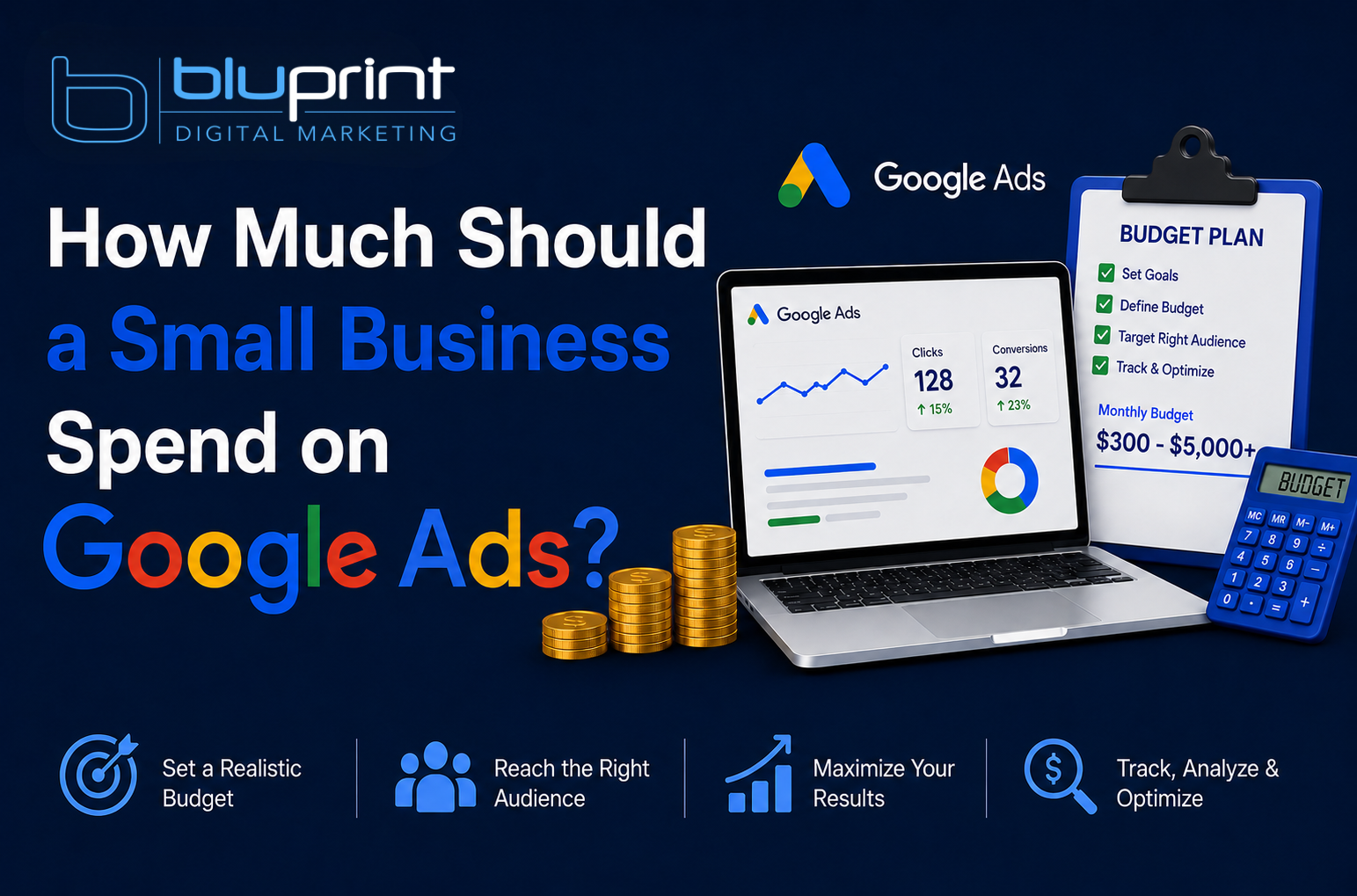
How Much Should a Small Business Spend on Google Ads?
It’s the first question almost every business owner asks when they’re thinking about running Google Ads — and it’s also one of the hardest to answer with a straight number, because the honest answer is: it depends.
But “it depends” isn’t useful, so let’s break it down in a way that actually helps you figure out the right number for your business.
First, Understand What You’re Actually Paying For
Before we talk numbers, there’s an important distinction most agencies gloss over: ad spend and management fees are two different things.
- Ad spend is the money that goes directly to Google. Every time someone clicks your ad, Google charges you. This money goes to Google, not your agency.
- Management fees are what you pay an agency or consultant to set up, manage, and optimize your campaigns.
When someone says “we spend $2,000 a month on Google Ads,” they might mean $2,000 total — or $1,500 in ad spend plus $500 in management fees. Always clarify which number you’re looking at.
At Bluprint, we’re transparent about this from day one. You always know exactly how much is going to Google and how much is our fee.
What’s the Minimum Viable Budget?
Here’s the uncomfortable truth: there is a floor below which Google Ads simply won’t work well enough to be worth it.
If your average cost-per-click in your industry is $8 and your daily budget is $5, you’re getting less than one click per day. That’s not a campaign — that’s a science experiment with no data.
As a general starting point for most local service businesses, we recommend a minimum of $500–$1,000 per month in ad spend. That gives Google enough budget to show your ads consistently, gather meaningful data, and start optimizing toward conversions.
Some industries can get by with less. Some need significantly more. Which brings us to the biggest factor in your budget decision.
Your Industry Determines Your Cost-Per-Click
Google Ads works on an auction system. The more competition there is for a keyword, the more each click costs. Some industries are dramatically more expensive than others.
Here’s a rough breakdown of average cost-per-click ranges by industry:
Lower cost ($1–$5 per click)
- Restaurants and food
- Arts and entertainment
- Real estate (browsing searches)
Mid range ($5–$15 per click)
- Home services (HVAC, plumbing, roofing)
- Auto repair and dealerships
- Fitness and wellness
- E-commerce
Higher cost ($15–$50+ per click)
- Legal services (attorneys, law firms)
- Financial services
- Medical and dental
- Insurance
If you’re a personal injury attorney in a major city, a single click might cost $50 or more. At that rate, a $500/month budget gets you 10 clicks — which isn’t enough to generate consistent cases. In that industry, serious advertisers are spending $3,000–$10,000+ per month just in ad spend.
On the other hand, a local hail repair shop in a mid-size market might see clicks at $4–$8, making a $500–$1,000/month budget genuinely effective.
How to Calculate the Right Budget for Your Business
Here’s a simple framework to work backwards from your goals:
Step 1: Know your close rate. If you get 10 leads, how many become paying customers? If it’s 3 out of 10, your close rate is 30%.
Step 2: Know your average job or transaction value. What does the average customer spend with you?
Step 3: Set a target cost-per-lead. How much are you willing to pay for one new lead? A good rule of thumb is no more than 10–20% of your average job value.
Put it together: Let’s say your average job is $1,500, your close rate is 25%, and you’re willing to pay up to $150 per lead. If your average cost-per-click is $6 and your landing page converts at 5%, you’re paying $120 per lead ($6 ÷ 5% = $120). That works.
Now set a monthly goal — say, 10 new leads per month. At $120 per lead, that’s $1,200/month in ad spend.
This isn’t an exact science, but it gives you a logical starting point instead of just picking a number out of thin air.
Should You Start Small and Scale Up?
Yes — with one caveat. Starting small is smart, but starting too small defeats the purpose.
Google’s algorithm needs data to optimize. If your budget is so tight that you’re only generating a handful of clicks per week, it can take months to gather enough information to meaningfully improve your campaigns. You’ll spend money, see mediocre results, and conclude that Google Ads doesn’t work — when the real issue was insufficient budget to reach the learning phase.
A better approach: start at a budget that gives you at least 5–10 clicks per day, run it for 60–90 days, analyze the data, then scale what’s working and cut what isn’t.
What About Ad Spend vs. Management Fee Ratio?
A common question is how much of your total Google Ads investment should go toward management fees versus actual ad spend.
There’s no universal standard, but a healthy ratio for small businesses is generally 70–80% ad spend, 20–30% management fee. If you’re spending $1,000 total, roughly $700–$800 should be going to Google and $200–$300 to whoever is managing the account.
Be cautious of agencies that charge a flat management fee that eats up a huge portion of your total budget — especially on smaller accounts. If your total budget is $600/month and the management fee is $500, only $100 is actually reaching Google. That’s not going to generate results for anyone except the agency.
The Bluprint Approach
We believe your budget should work for you, not for us. That’s why our management fees are fixed monthly rates — not a percentage of your ad spend. You know exactly what you’re paying for management and exactly what’s going to Google, and we’ll never recommend a budget that doesn’t make sense for your goals and your market.
Whether you’re starting at $500/month or $5,000/month, the goal is the same: make every dollar accountable.
If you’re not sure what the right budget is for your business, let’s talk. We’ll look at your industry, your market, your competitors, and give you an honest recommendation — no obligation, no pressure.
Quick Reference: Budget Guidelines by Business Type
| Business Type | Suggested Monthly Ad Spend |
|---|---|
| Local service (low competition market) | $500 – $1,000 |
| Local service (competitive market) | $1,000 – $3,000 |
| E-commerce (starting out) | $1,000 – $2,500 |
| Legal / medical / financial | $2,500 – $10,000+ |
| Multi-location or regional | $3,000 – $15,000+ |
–
These are starting points, not guarantees. Your actual numbers will depend on your market, your goals, and how well your campaigns are optimized.