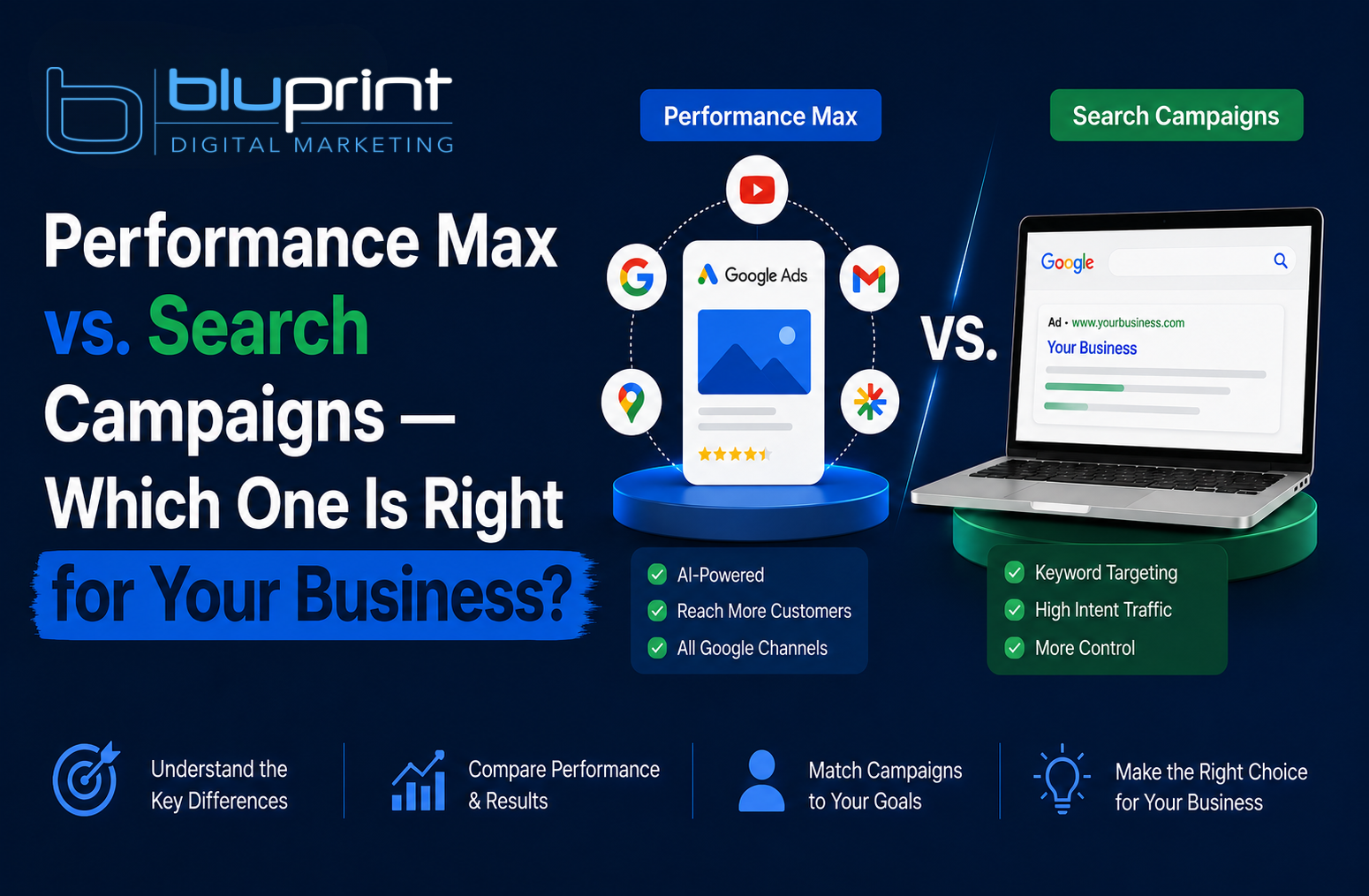
Performance Max vs. Search Campaigns — Which One Is Right for Your Business?
If you’ve logged into Google Ads recently, you’ve probably noticed Google pushing Performance Max pretty hard. It’s their newest, most automated campaign type — and depending on who you ask, it’s either the future of digital advertising or a black box that burns through your budget while you watch helplessly.
The truth, as usual, is somewhere in the middle.
Both Performance Max and Search campaigns have a place in a well-built Google Ads strategy — but they serve very different purposes, and choosing the wrong one (or using both the wrong way) is one of the most common and costly mistakes we see small business owners make.
Let’s break down what each one actually does, where each one wins, and how to decide what’s right for your business.
What Is a Google Search Campaign?
Search campaigns are the original Google Ads format — the text ads that appear when someone types a specific query into Google.
You choose the keywords you want to target, write the ads, set your bids, and your ads show up when someone searches for those terms. It’s intent-based advertising at its core: you’re reaching people at the exact moment they’re actively looking for what you offer.
What you control with Search:
- Exactly which keywords trigger your ads
- The specific ad copy shown
- Bids by keyword, device, location, and time of day
- Where your traffic goes (which landing page)
- Negative keywords to block irrelevant searches
Search campaigns are transparent. You can see exactly which search terms triggered your ads, which keywords are driving calls, and where your money is going. That level of visibility makes it easier to optimize, cut waste, and scale what’s working.
What Is Performance Max?
Performance Max (PMax) is Google’s fully automated, all-in-one campaign type. Instead of targeting specific keywords, you provide Google with your assets — headlines, descriptions, images, videos, and audience signals — and Google decides where, when, and who to show your ads to across every channel it owns.
That means your ads could appear on:
- Google Search
- Google Display Network
- YouTube
- Gmail
- Google Discover
- Google Maps
- Google Shopping
One campaign, every channel. Google’s algorithm figures out the optimal combination of placements, audiences, and creative to hit your conversion goals.
What you control with PMax:
- Your creative assets (headlines, images, video)
- Audience signals (suggestions, not requirements)
- Budget and bidding strategy
- Conversion goals
What Google controls:
- Where your ads show
- Who sees them
- Which creative combinations run
- How budget is distributed across channels
The Key Difference: Intent vs. Reach
Here’s the simplest way to think about the two:
Search = capturing demand that already exists. Someone is actively searching for your product or service right now. Search puts you in front of them at that exact moment.
Performance Max = creating and capturing demand across the entire Google ecosystem. PMax reaches people across multiple touchpoints — some who are searching, some who are browsing YouTube, some who are checking Gmail. It’s broader, more automated, and less predictable.
Where Search Campaigns Win
Search is the better choice when:
Your business is driven by urgent, high-intent searches. Think emergency plumber, hail damage repair, DUI attorney, or any business where people need help right now and go straight to Google to find it. These customers are searching with purpose and ready to act. Search captures them at exactly the right moment.
You need transparency and control. If you want to know precisely which keywords are driving leads, what your cost-per-conversion is by keyword, and where every dollar is going, Search gives you that visibility. PMax doesn’t.
You’re working with a smaller budget. Search is more efficient at lower budgets because it focuses your spend on high-intent moments rather than spreading it across multiple channels. PMax needs more budget to gather data across all its placements before it starts optimizing effectively.
You’re in a competitive local market. For local service businesses competing for clicks in a specific geographic area, Search campaigns with tight keyword targeting and strong negative keyword lists consistently outperform the broad reach of PMax.
Where Performance Max Wins
PMax is the better choice when:
You have strong conversion data for Google to learn from. PMax’s algorithm optimizes based on conversion signals. The more conversion data you have — calls, form fills, purchases — the smarter it gets. If you’re a newer advertiser with limited history, PMax won’t have enough to learn from and will spend inefficiently.
You want to reach customers across multiple touchpoints. If your sales cycle is longer and customers need to see your brand multiple times before converting — think higher-ticket services, B2B, or e-commerce — PMax’s multi-channel reach can be a real advantage.
You’re running e-commerce with a product feed. PMax was built to replace Smart Shopping campaigns, and for e-commerce businesses with a Google Merchant Center feed, it tends to perform very well.
You have the budget to fund both upper and lower funnel activity. PMax works best when you have enough budget to appear across multiple channels consistently. On a tight budget, the spend gets diluted across too many placements to be effective at any of them.
The Problem With Running PMax Without Search
This is where a lot of small businesses get burned.
Google is actively pushing advertisers toward Performance Max — it’s more automated, which means less hands-on management from advertisers, and it gives Google more control over where your money goes. That’s not inherently bad, but it creates a real risk for businesses that switch to PMax exclusively.
Without a Search campaign running alongside it, PMax will often cannibalize branded searches — showing up when people search your own business name — and inflate your conversion numbers with easy wins that would have happened anyway. Meanwhile, the high-intent non-branded searches that actually grow your business may not be getting the focused attention they deserve.
The other issue is transparency. PMax’s reporting is limited. You can’t see a full breakdown of which search terms triggered your ads, which placements your budget went to, or which creative combinations drove results. You’re trusting Google’s algorithm completely — which is fine if it’s performing, but very difficult to diagnose when it isn’t.
The Right Strategy for Most Small Businesses
For the majority of local service businesses, the most effective approach is:
- Lead with Search. Build tightly structured Search campaigns with strong keyword targeting, well-written ad copy, and an aggressive negative keyword list. This is your foundation — the most controllable, most transparent, and most efficient way to capture high-intent local leads.
- Layer in Performance Max once you have data. Once your Search campaigns are generating consistent conversions and Google has real data to learn from, PMax can expand your reach and catch customers at additional touchpoints. Think of it as amplifying what’s already working, not replacing it.
- Watch for cannibalization. If you run both, monitor your Search campaigns for drops in impression share and conversions after adding PMax. Set brand exclusions so PMax isn’t just eating credit for searches that would have converted anyway.
The Bottom Line
Performance Max isn’t magic, and Search campaigns aren’t obsolete. They’re different tools for different jobs — and the businesses that get the most out of Google Ads are the ones using each tool for what it’s actually good at.
If you’re not sure which one is right for your business — or if you’re running both and not sure if they’re working together the way they should — we’re happy to take a look. At Bluprint, we manage both campaign types every day and know how to structure them so they complement each other instead of competing.
Schedule a free consultation and let’s talk through what your Google Ads strategy should actually look like.