What Is a Good Click-Through Rate for Google Ads — and Why It Matters
If you’ve been running Google Ads for more than a week, you’ve probably noticed the CTR column in your campaign dashboard. Click-through rate — the percentage of people who see your ad and actually click on it — is one of the most watched metrics in digital advertising. But knowing what number to aim for is something a lot of business owners struggle with.
The short answer is that it depends on your industry, your campaign type, and what you’re advertising. The longer answer is more useful — so let’s get into it.
What CTR Actually Measures
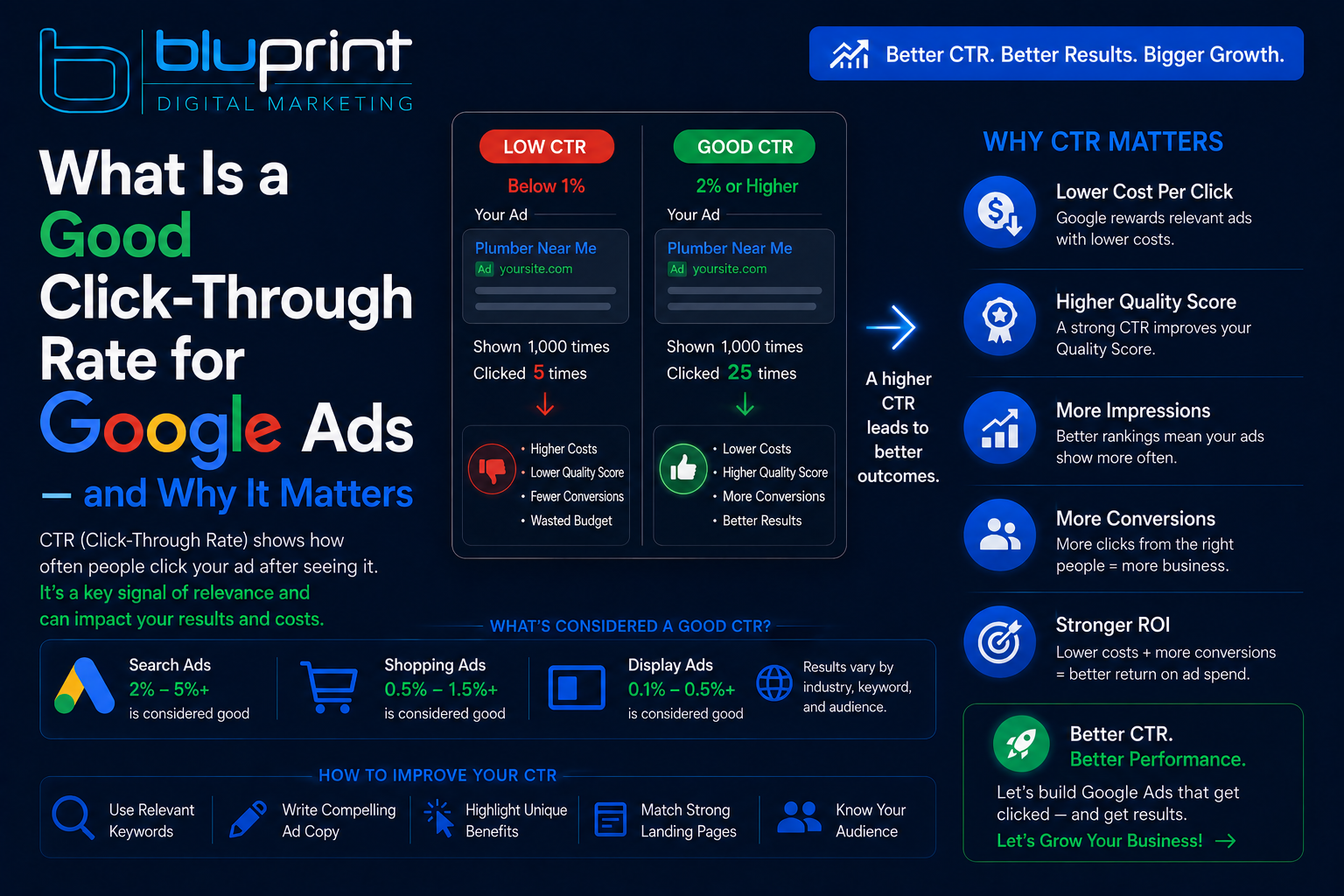
Click-through rate is simply the number of clicks your ad receives divided by the number of times it was shown (impressions), expressed as a percentage. If your ad was shown 1,000 times and received 30 clicks, your CTR is 3%.
CTR is important for two reasons. First, it tells you whether your ad copy is resonating with the people who are seeing it. A low CTR means your ad isn’t compelling enough to make people stop scrolling and take action. Second, CTR is a factor in your Quality Score — Google’s internal rating of how relevant and useful your ad is. A higher Quality Score typically leads to lower costs and better ad placement.
What’s Considered a Good CTR
Industry benchmarks for Google Search campaigns typically fall in the range of 3-5% for most service-based businesses. That said, context matters significantly.
A highly targeted Search campaign using exact match keywords for a specific service in a specific location should achieve a higher CTR — often 6-10% or more — because the people seeing the ad are searching for exactly what you offer. The Dentagon Colorado Springs Search campaign we manage, for example, consistently runs above 7% CTR because the keywords, ad copy, and audience are tightly aligned.
A broader Performance Max campaign will almost always show a lower CTR — sometimes 0.5-2% — because it’s reaching a much wider audience across multiple Google networks including Display and YouTube. That’s not necessarily a problem. The metrics that matter for Performance Max are conversions and cost per conversion, not CTR.
What a Low CTR Usually Means
If your Search campaign CTR is consistently below 2-3%, something is off. The most common causes are ad copy that doesn’t match the search intent, keywords that are too broad and attracting the wrong audience, or ads that aren’t differentiated enough from competitors in the auction.
The fix is usually a combination of tightening your keyword targeting, rewriting your headlines to be more specific and benefit-driven, and making sure your call to action is clear and compelling. Generic ads get generic results. The more specific and relevant your ad is to exactly what someone searched for, the higher your CTR will climb.
What a High CTR Doesn’t Guarantee
Here’s something that surprises a lot of business owners — a high CTR doesn’t automatically mean your campaign is successful. You can have a 10% CTR and still be losing money if those clicks aren’t converting into leads or sales.
CTR measures how good your ad is at getting clicks. Conversion rate measures how good your landing page and offer are at turning those clicks into customers. Both matter, and they need to work together. An ad that attracts the wrong clicks with misleading or overly broad copy might generate a high CTR but a terrible conversion rate — and a terrible return on your ad spend.
The goal is always clicks from the right people at the right cost converting into actual business at a profitable rate. CTR is one piece of that puzzle, not the whole picture.
How to Improve Your CTR
The most effective ways to improve CTR on a Search campaign come down to relevance and specificity. Use your target keyword in your headline. Speak directly to what the person is looking for. Lead with your strongest differentiator — whether that’s a free estimate, a warranty, a certification, or something unique to your business. Use numbers when you can. Make your call to action clear and urgent.
Negative keywords also play a role. If your ad is being shown to people searching for things that aren’t relevant to your business, those impressions drag your CTR down without any benefit. A clean negative keyword list keeps your ad showing only to people who are genuinely looking for what you offer.
The Bottom Line
A good CTR for Google Ads Search campaigns is generally 3-5% for most businesses, with well-optimized campaigns in specific service categories often achieving 6-10% or higher. If your CTR is falling below 2%, it’s worth taking a hard look at your keyword targeting and ad copy before spending another dollar.
If you’re not sure where your campaigns stand or why your CTR isn’t where it should be, Bluprint Digital Marketing offers free campaign audits for Colorado businesses. We’ll tell you exactly what’s working, what isn’t, and what to do about it.